


AI and automation are producing more findings across science, mathematics, and vulnerability research. Some are verified results. Others are predictions, conjectures, tentative proofs, or suspected bugs. Generating a claim and establishing it are different achievements.
Security researchers have long dealt with static-analysis false positives and their review burden. AI has amplified that burden in some programs. Science and mathematics have always needed scrutiny, too; cheaper generation makes the capacity to provide it a more pressing question.
The benefits of a compute donation can sometimes accrue to different people from those who bear the costs of checking its outputs. A useful gift should account for both.
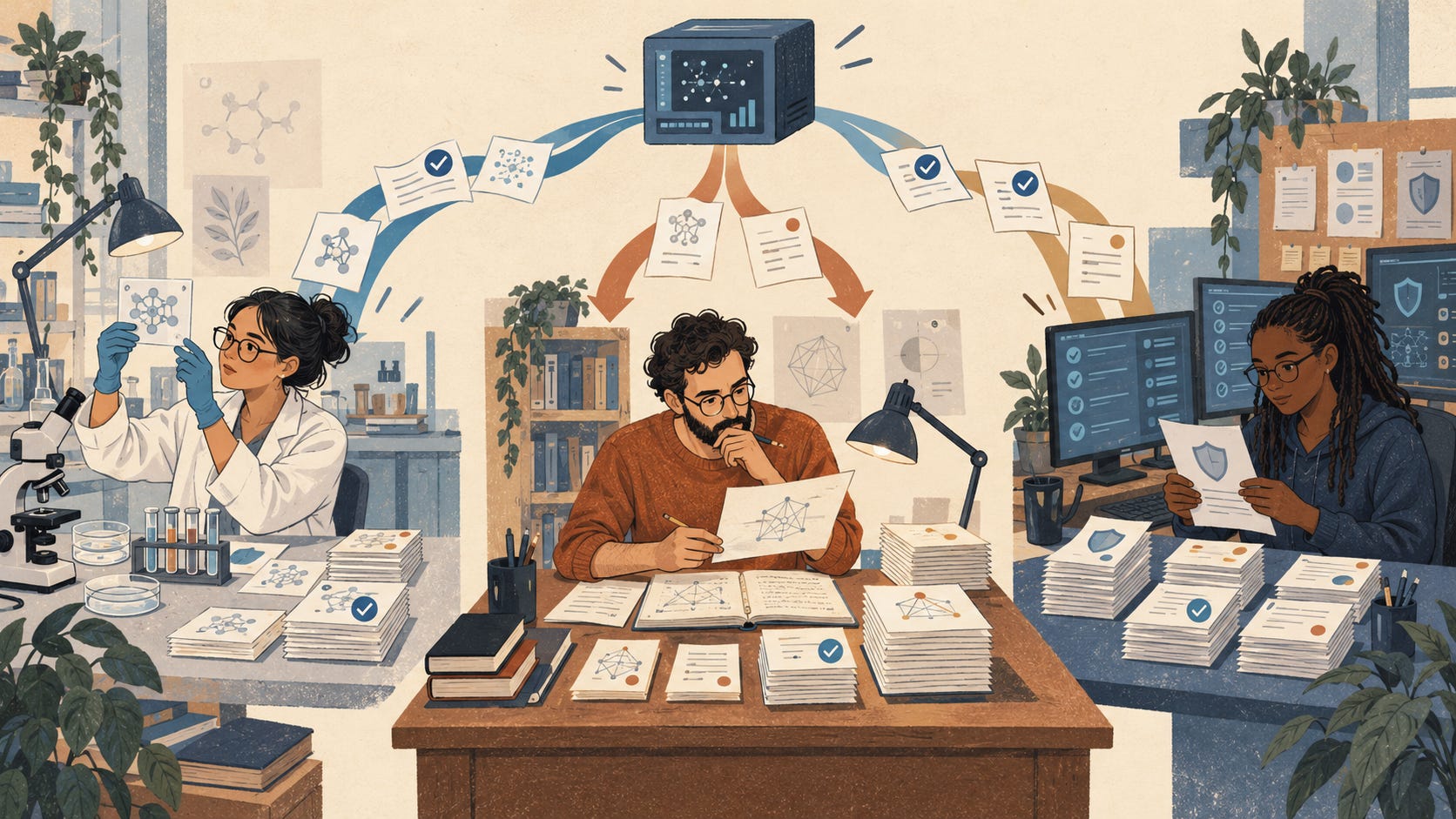
From compute to knowledge
The October 8 DeepMind Institute essay gives us a reason to examine this imbalance. Its underlying study surveyed 637 US and UK scientists, reporting average self-reported net time savings of 6.9 hours a week and growing hypothesis backlogs for about 41%. These are non-representative survey findings, rather than measurements of faster discovery. They do not establish that compute donations cause unfunded validation work.
The donations themselves are substantial. Google committed $40 million in AI tokens and cloud credits to the US Department of Energy’s Genesis Mission. Anthropic announced A$3 million in Claude API credits for four Australian research institutions. Their scientific value depends on what researchers establish with them.
Testing can establish concrete results. Laboratory tests of AI-designed nanobodies identified improved binding to particular SARS-CoV-2 variant spike proteins. That establishes a specific assay result, without demonstrating clinical benefit or a general acceleration of science. The testing is what carries the claim beyond a promising design.
Security’s familiar problem
Open-source security shows what happens when the work after discovery becomes scarce. Ben Livshits’s “Mutiny on the Bounty” examines this asymmetry: automated discovery gets cheaper while verification and remediation still consume attention. His proposed response includes checkable evidence, funded triage, and rewards for usable fixes.
An unverified AI bug report is a candidate finding. It may describe a genuine vulnerability, a false positive, or behavior that falls outside the project’s security assumptions. A convincing explanation can take hours to investigate. curl’s bounty had helped identify 87 confirmed vulnerabilities. In 2025, however, fewer than 5% of submissions became confirmed vulnerabilities. In January 2026, the project ended the paid scheme after a flood of AI-generated and other low-quality reports. Private security reporting continued.
Improving report quality does not eliminate the workload. By April, curl’s maintainer reported much better submissions, while warning that their volume still threatened overload. Anthropic’s October scanner announcement reported over 29,000 candidate vulnerabilities, with approximately 6,000 manually reviewed and triaged. It identified human validation capacity as a bottleneck. These accounts document processing costs, without showing that a particular token donation caused curl’s closure.
Proofs need people
Mathematics needs expert attention after generation. OpenAI’s October 6 release contains 372 result families, with varying verification status and Lean formalizations for some. This is released research output rather than donated compute. Proposed proofs deserve the scrutiny expected of human proofs.
Lean supplies powerful verification of the encoded statement. Someone must still check that its definitions and assumptions capture the advertised claim. An October preprint reported mismatches between intermediate statements in OpenAI’s Navier–Stokes prose proof and its formalization. One prose estimate was stronger than its formal counterpart. The authors did not claim to disprove the theorem. Checking a formal proof and its correspondence to a paper are separate tasks.
Verification also has an incentive problem. Terence Tao describes refereeing as largely uncredited and less prestigious than producing proofs. Confirming somebody else’s breakthrough may also feel less satisfying than discovering your own. That is a plausible obstacle to investigation, and a reason to make verification a funded scholarly contribution.
A fund for validation
Existing efforts offer a starting point. OpenAI promised programs supporting understanding of AI mathematics. Anthropic’s Project Glasswing committed up to $100 million in usage credits alongside $4 million in donations to open-source security organizations.
I would pair scientific compute donation programs with an independently administered validation fund. Providers contribute cash; foundations, public funders, and commercial beneficiaries help match it. An established science funder allocates grants through field specialists and methodologists, including experimentalists and researchers from under-resourced institutions. Donors disclose conflicts and receive no award vote or publication veto.
Applications should identify consequential claims, their provenance, credible tests, controls, interpretation criteria, and budgets. Record model versions and predictions before testing. Fund original investigators and independent replication teams, with the latter controlling their budgets and publication.
Match funding to the work required. Biology may need technicians and reagents; materials research, synthesis and characterization; mathematics, proof scrutiny and explanatory working groups. Computational disciplines may need independent implementations, held-out data, and tests of alternative assumptions. Retail token prices cannot determine these budgets, and repeating the same simulation may preserve the same mistake. Shared methods expertise and testing facilities could help smaller laboratories participate.
An open-source equivalent would fund triage, patch review, regression tests, and maintainer time through project-approved processes. Scientific grants would support experiments, interpretation, reporting, and archiving. Both should pay for informative investigation.
Making verification count
For science, Registered Reports offer a useful model: review questions and methods before results, with publication commitments subject to agreed standards. Register funded tests, issue citable reports, and give confirmations, negative findings, and explanatory work credit in future grants. An underpowered null result is not a refutation.
On a personal note, we could all do more to celebrate work that confirms a result or disproves it. We have the Journal of Irreproducible Results, albeit humorous. We could do with a Journal of Reproduced Results, but serious.
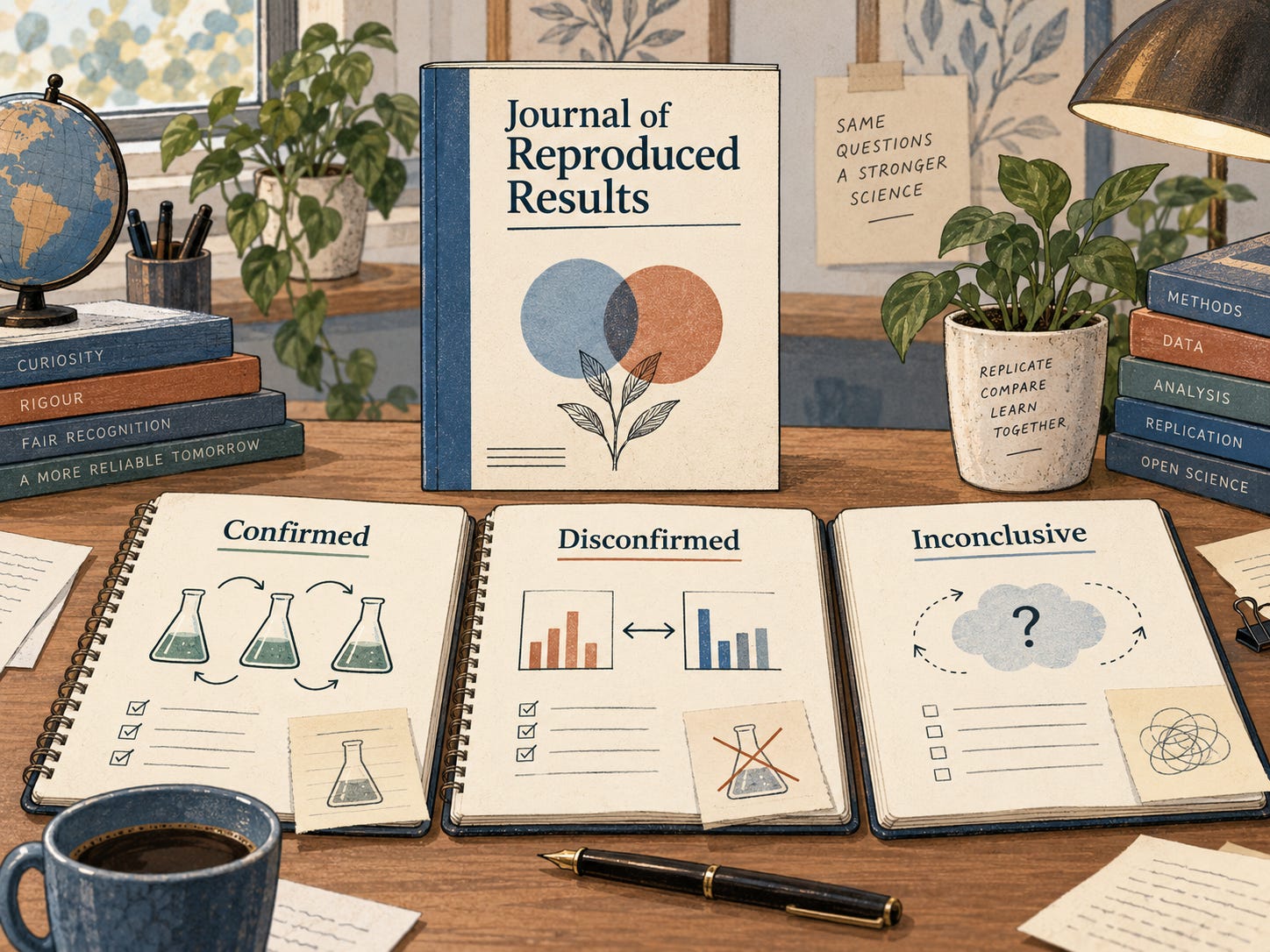
Keeping access open
The strongest objection is that additional conditions could discourage gifts already helping underfunded researchers. Compute can also eliminate weak candidates before expensive experiments. Keep access separate: researchers should supply no matching cash and lose no credits when a validation bid fails. Start with a voluntary pool and short applications. Assess informative completed work, access delays, and administrative burden.
Measure the gift by knowledge established: effects confirmed, claims rejected, uncertainty narrowed, and results made usable. The most convincing donation would fund a result the donor would rather not put on its homepage.